The problem#
Stereo depth networks are trained almost entirely on synthetic data and on rectified pinhole image pairs. Real 360° cameras on a vehicle give neither: the images are heavily distorted equirectangular panoramas, and rectifying them needs careful calibration that does not survive outside the lab. Existing 360° depth datasets (Matterport3D, Stanford 3D) are synthetic or rendered, so there was nothing realistic to train or evaluate on.
What I built#
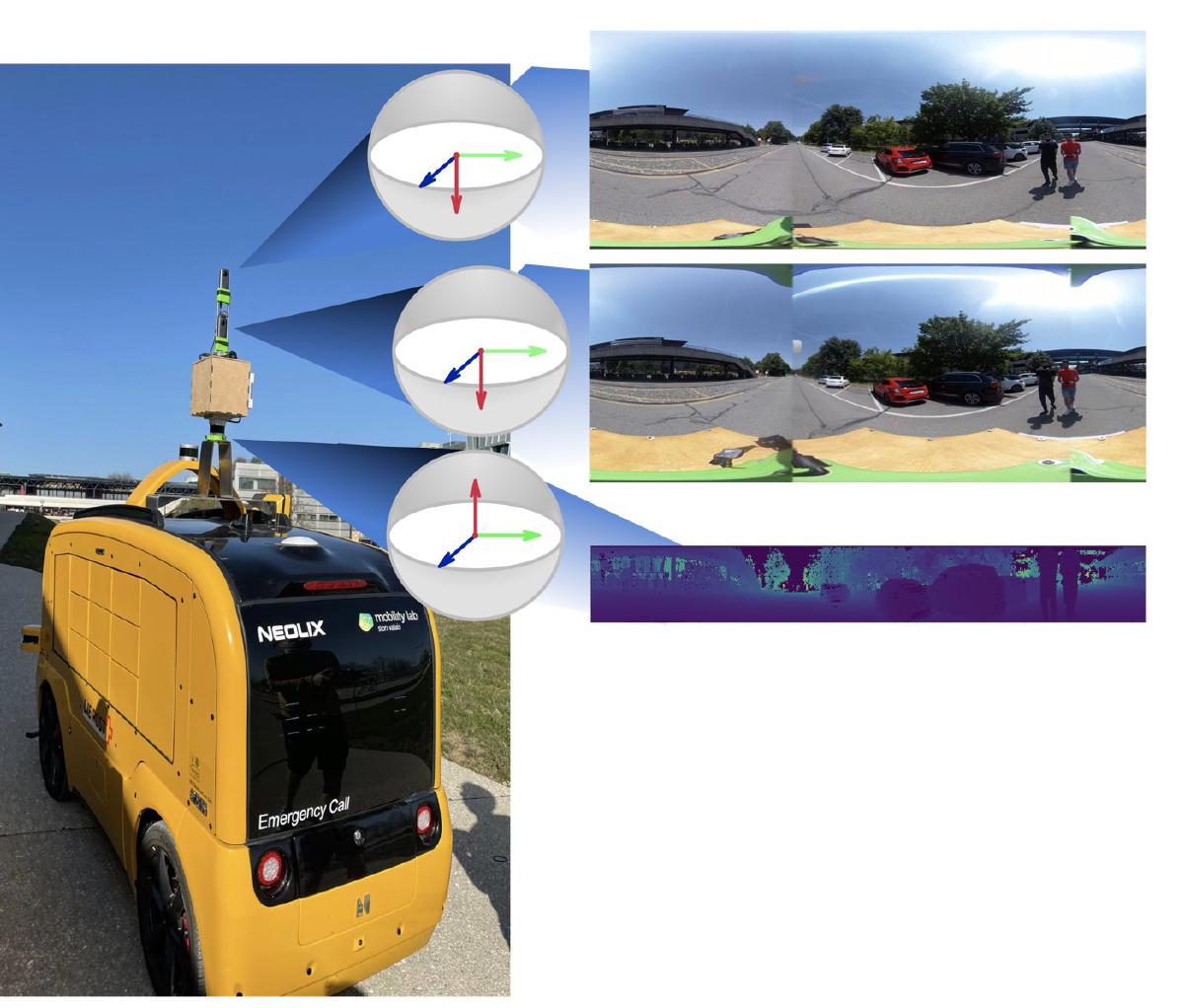
A new dataset. I designed and recorded a real-world dataset with two RICOH Theta 360° cameras stacked vertically above an Ouster OS1-64 LiDAR, at EPFL in Lausanne.
- 17,373 time-synchronised tuples (upper image, lower image, LiDAR depth image and point cloud) across two outdoor street scenes and two indoor corridors.
- 3840 × 1920 stereo images, with LiDAR depth images at 1024 × 64 as ground truth (depth, not disparity).
- Deliberately left unrectified, to make the dataset closer to what a deployed system sees. I removed the LiDAR distortion and aligned its panoramic output with the camera format so the three streams line up.
A network that works on it. I benchmarked PSMNet and 360SD-Net, then modified 360SD-Net to train on the new data: a feature extractor with residual blocks and dilated convolutions, an ASPP module for context, a cost volume regularised by a stacked-hourglass 3D CNN, and depth regression. The polar angle of each pixel is fed in through a separate branch and fused late, to give the network the distortion pattern of the equirectangular projection. Trained for 500 epochs in PyTorch.
Results#
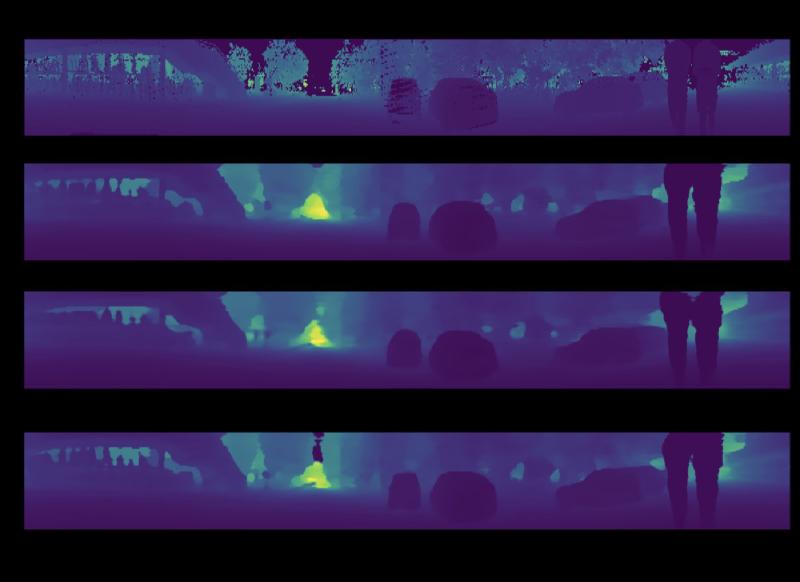
- Out of the box, 360SD-Net did not cope with the unrectified pairs (RMSE in the thousands on the Outdoor 1 scene); the modified network reached an RMSE of 0.9 on the same scene.
- Ablations showed larger input crops help (256 × 512 beat 256 × 256), while the polar-angle branch contributed little on this dataset, so it can be dropped to cut compute.
- The dataset, released to the lab, gives a harder and more realistic benchmark for 360° stereo depth than the synthetic alternatives.